Since 1 July 2026 every retailer has to offer a plan with three free hours — 11am to 2pm
in South East Queensland, at least 24 kWh a day. Your battery charges from the grid at $0
in that window, so it fills whether or not the roof made enough. You have to opt in, and
the house needs a smart meter.
The catch: these plans carry a higher daily supply charge — around $1.06 a day more is what
customers are reporting. That is already taken off the savings shown. It is also why a bigger
battery makes more sense than a small one on these plans: the extra charge is the same either way.
Your Usage Pattern
10%65%
Of all the power your home uses, how much goes before dark. Most homes are 40-50%. This is about your household, not your panels - how much of your solar you actually use is worked out for you below.
This is a typical profile, not your meter. Nobody knows the real day/night split
until we read an actual bill — and it is the number every figure on this page hangs off.
We check it on the free site visit and requote if it moves.
Hot water on a timer, pool pump, EV charging, dishwasher and washing on a delay start.
Typical: hot water 8–10 · pool pump 4–6 · EV 10. This is the cheapest win on
the job, and it takes the midday surplus before the battery does — using a kWh as you
make it beats storing it and losing 10% in the round trip. Shift first, then size the battery
for whatever is genuinely left after dark.
Already on an off-peak rate (about 22c), so moving it to solar saves that, not the full 33c. Worth doing — just honest about the size of it.
Single-phase homes export at max 5 kW — big systems earn less feed-in unless three-phase.
Got a quote?
Commercial systems are quoted individually, so we do not guess a price here. Put your quoted figure in and you will get payback against it.
Estimated Annual Savings
$0
Payback Period
— years
25-Year Net Savings
$0
Price After Rebate
$0
New Monthly Bill
—
Where Every kWh Goes per day
Used as madeStored for nightExportedStill bought from grid
✓No cheap gear — quality components built to last 25+ years
Want this modelled on your actual roof?
Everything above is an estimate. It assumes a typical split between daytime and
after-dark use, and a well-oriented roof — because at this point we have never
seen your place.
Before you spend anything, we build the real thing: your roof traced off
high-resolution aerial imagery, every panel placed where it will actually
go, the tilt and orientation of each roof plane taken properly into account,
and a 3D shading study that accounts for your trees, your neighbour’s,
and your own gables — hour by hour, right through the year.
What comes back is production for your address and your roof, not for a
typical Sunshine Coast one — plus the panel layout you would actually get, so you
can see it before anybody drills a hole.
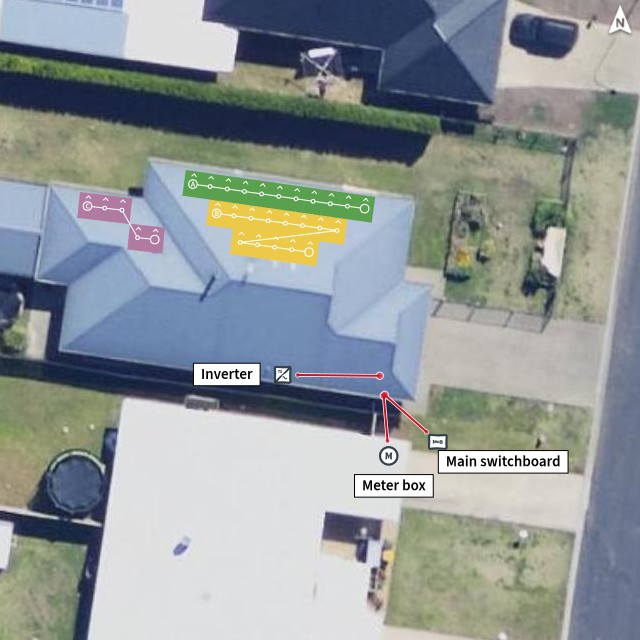
A real design of Bart’s. Every panel placed on the actual roof, the strings
colour-coded, and the inverter, meter box and main switchboard located — before
anyone turns up. Address removed.
We design in Pylon, the platform a lot of
Australian installers use for this. It is part of the free site assessment —
there is no charge for it and no obligation to go ahead.
⚠️ Estimation only. Actual savings, production and costs vary based on roof orientation, shading, usage patterns, retailer tariffs and site-specific factors. Book a free assessment for a fixed-price quote.
We'll send your full breakdown — including what it's worth if you wait until January.
✓ Sent! Your PDF breakdown is on its way to your inbox — have a look in junk if it is not there in a minute.
Something went wrong — call 0419 103 648 and we'll sort it straight away.
Estimates only. Actual savings depend on usage, orientation, shading & retailer. Assumes 33.3c/kWh import, tiered feed-in (10c to 8 kWh/day, then 2c), ~$1.36/day supply charge (not removable), 4.2 kWh per kW per day (a well-oriented Sunshine Coast roof), 90% battery round-trip, 0.4%/yr panel degradation; battery contribution counted to year 15. Federal rebates already deducted in prices shown (battery: ~$252/usable kWh on the first 14 kWh at $37/STC; steps down 1 Jan 2027).